The Trader’s Doom Loop: When Risk Destroys Rationality
The Trader’s Doom Loop: When Risk Destroys Rationality
Introduction: How significant market moves, cognitive biases, oversized positions, stress and poor sleep can
reinforce destructive trading behaviour.
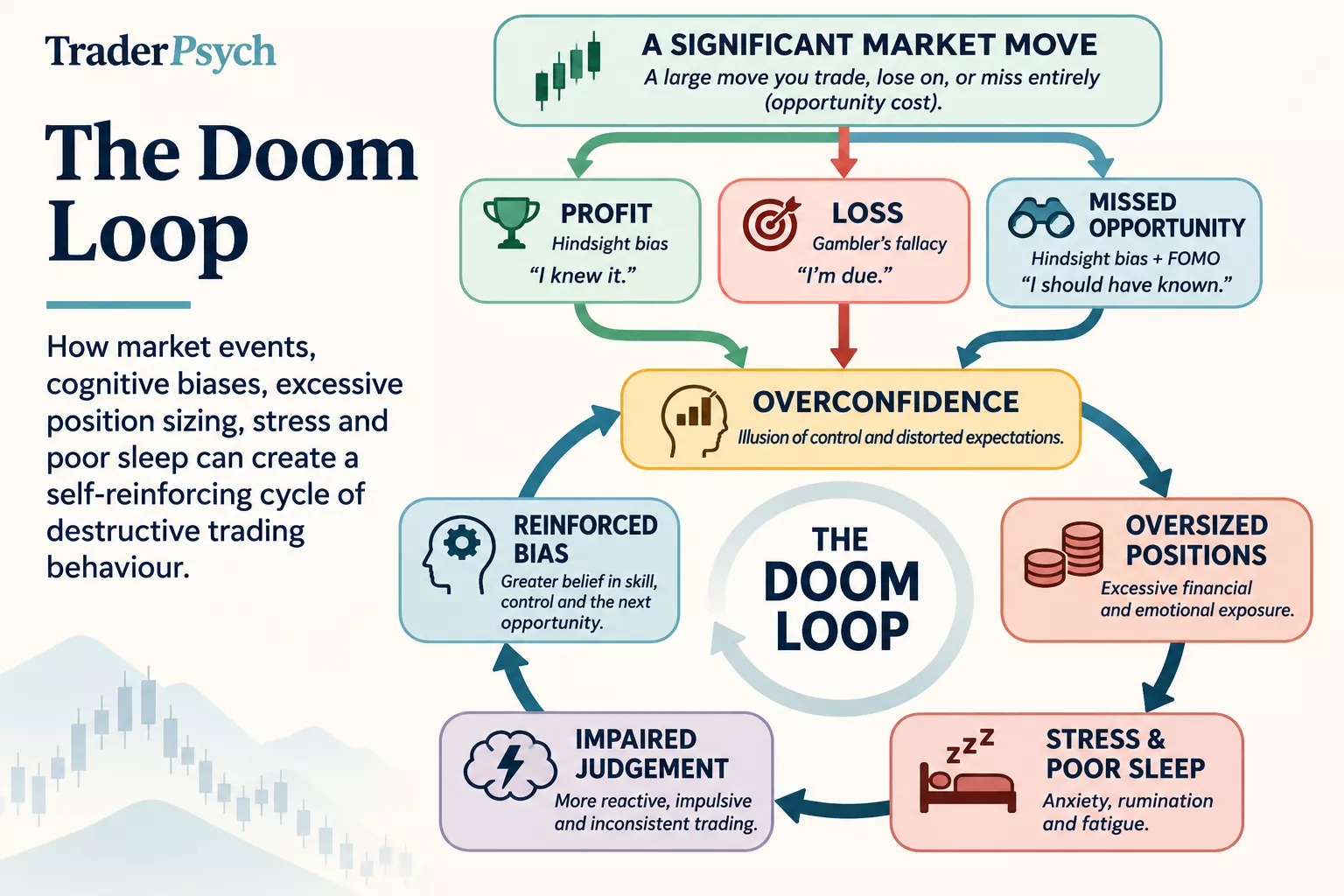
The Catalyst: A Significant Market Move
The doom loop need not begin with a profit or loss. A major move that a trader watches from the sidelines can
create a perceived loss through opportunity cost. Although no capital was lost, the foregone profit becomes a
powerful psychological reference point. Hindsight bias makes the move seem obvious after the event, prompting
regret, fear of missing out and the urge to compensate with a larger trade.
Winning: The Illusion of Skill
After a profitable trade, hindsight bias makes the outcome appear more predictable than it was. Traders may
credit skill rather than chance or market conditions. This reinforces the illusion of control and overconfidence,
encouraging position sizes that exceed any demonstrated trading edge.
Losing: The Gambler’s Fallacy
Following losses, a trader may believe a favourable outcome is now “due”. Where outcomes are independent,
this is the gambler’s fallacy. The desire to recover losses can drive revenge trading, doubling down and the
abandonment of risk limits. Genuine mean reversion is different: it requires evidence, not an assumption that a
losing streak must reverse.
Oversized Positions: The Tipping Point
Large positions increase both financial and emotional exposure. Anxiety, constant monitoring and rumination can
interfere with sleep. Stress and sleep deprivation may impair attention, emotional regulation and impulse control,
making reactive decisions more likely. Not everyone responds to stress by taking more risk, but it can undermine
consistent adherence to a trading plan.
The Self-Reinforcing Cycle
Significant market move → perceived win, loss or missed opportunity → biased interpretation →
distorted confidence or expectations → oversized positions → stress and poor sleep → impaired
judgement → further reactive trading. A trader may become least capable of managing risk precisely when
exposure is greatest.
Breaking the Doom Loop
Predetermined position sizing, portfolio risk limits, systematic entry and exit rules, and independent performance
evaluation help separate decisions from recent outcomes. Record forecasts and reasons before trades, then
evaluate decisions against the information available at the time. Recognise fatigue and emotional arousal as
reasons to reduce discretionary risk, not increase it.
The Central Lesson
The greater the risk a trader takes, the more their psychological capacity to manage that risk may
deteriorate. The loop can start with a missed opportunity as easily as a realised profit or loss. Good risk
management protects the decision-making process from the psychological consequences of market exposure